Face shape guide
Diamond Face Shape
A diamond face shape is a little longer than it is wide, with the cheekbones as its widest point. The forehead and the jaw both taper inward from there, and the chin finishes in a point. Picture a gem standing on its tip.
Your high cheekbones are the feature people try to fake with contour. What you manage is the narrowness at the temples and jaw: add a little fullness in those two zones and the face reads as balanced.
How to tell if you have a diamond face shape
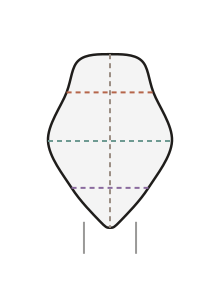
- Length vs width
- A little longer than it is wide
- Widest part
- The cheekbones; forehead and jaw are both narrower
- Jawline
- Narrow, tapering toward the chin
- Chin
- Pointed
- Measure across your cheekbones, from the outer point under each eye. On a diamond face this is clearly the largest of your three widths.
- Measure your forehead halfway between brows and hairline, and your jaw from one jaw angle to the other. Both come out clearly smaller than the cheekbones, and close to each other.
- Measure length from the centre of your hairline to the tip of your chin. It should be a bit greater than the cheekbone width, not dramatically longer.
- Few faces are textbook. Many diamonds lean toward heart or oval, and weight changes or age can tip a borderline face either way. Use whichever guide looks right on you.
Diamond vs heart
Both end in a pointed chin. Compare forehead and cheekbones: if your forehead is as wide as or wider than your cheekbones, you are a heart. If the forehead narrows noticeably at the temples, you are a diamond.
Diamond vs oval
Ovals are also widest at the cheekbones, but taper gently to a rounded chin. A diamond steps in sharply at the temples and ends in a point.
Diamond vs triangle
Triangles also have a narrow forehead, but the jaw is the widest part and the chin is flat. On a diamond the jaw is narrow, so the outline closes in below the cheeks instead of flaring out.
Best hairstyles for a diamond face
- Chin-length bob with ends that flip slightly out. Of all the diamond face hairstyles, this does the most: the volume lands right beside the narrow jaw and fills it in.
- Long side-swept fringe that crosses the forehead and ends near the outer brow. It widens the top third without hiding your cheekbones.
- Shoulder-length lob with soft waves that start at the jaw, smooth at the cheekbones.
- Curtain bangs cut to brow level and blown away from the face. They add width exactly where your temples narrow.
- Long layers that begin at the chin, worn with loose curls or a round-brush blow-dry. The layering adds bulk at the jaw and below.
Hairstyles to avoid
- Volume at the cheekbones, such as big side-teased hair at ear height. It makes the widest part wider still.
- Slicked-back ponytails and tight buns with no face-framing pieces. They expose both narrow zones at once and leave the cheekbones looking sharp.
- Centre-parted, poker-straight hair that hangs flat past the chin. It draws a long vertical line and narrows the forehead further.
Men's haircuts
- Textured fringe or crop: keep 5–8 cm on top and push it forward and slightly to one side. The fringe adds width across your narrow forehead.
- Side-swept quiff with a medium fade. Keep the fade low so the sides don't vanish at cheekbone height and make the face look even more pointed.
- Shoulder-length hair tucked behind the ears. The length fills in beside your jaw and works well with a beard.
Beard styles
- Full beard kept fuller at the chin and along the jaw: this squares off the pointed chin and is the strongest single change you can make.
- Short boxed beard with a straight, horizontal line under the chin. It adds the width your lower face lacks.
- Avoid goatees and chin-strap styles that sharpen the point. If you wear a goatee, keep it wide and squared rather than tapered.
Glasses for a diamond face shape
- Cat-eye
- Oval
- Browline
Your face is angular at the cheekbones and chin, so by the contrast rule, curved frames soften it. On a diamond, weight placement matters most: a defined browline or lifted outer corner widens the narrow forehead. Keep the frame front about as wide as your cheekbones, and let the top rim follow your brows.
- Oval or rounded rectangle frames: soft curves suit the angles of your cheekbones and chin.
- Cat-eye frames with a lifted upper corner. The upswept line widens the brow area, which is the part you want to build.
- Rimless or semi-rimless frames with a strong browline. A bar along the top adds width above the eyes and keeps the lower face light.
- Frames as wide as your cheekbones, not wider. Measure across the cheekbones and keep the frame front within a few millimetres of that.
Frames to avoid
- Narrow, small frames that sit inside the cheekbones. They make the cheekbones look even broader.
- Bottom-heavy frames, where the thick part of the rim sits low. They draw the eye down to the narrow chin.
Makeup and contouring
- Fill and slightly extend the tail of each brow outward. Straight to softly arched brows widen the forehead; very high, sharp arches lengthen it.
- Apply blush as a soft horizontal sweep from the apple toward the ear, a little below the cheekbone. This fills the hollow and keeps the focus off the cheekbone peak.
- Draw the eye outward with liner or shadow that extends past the outer corner. Width at eye level helps the temples look fuller.
Where to contour, highlight and blush
- Contour lightly, if at all, under the cheekbones. They are already your widest point, so deep hollowing makes the face look gaunt.
- Shade the tip of the chin with a matte bronzer to blunt the point. Blend down onto the neck so there's no edge.
- Highlight the temples and the outer forehead, close to the hairline. Light here makes the narrow top third read wider.
Diamond face shape questions
It depends on the rest of the outline. If your forehead and jaw are both clearly narrower and your chin is pointed, you have a diamond face. If they taper only slightly and your chin is rounded, you're closer to oval. Wide cheekbones with an equal length and width usually mean a round face.
Yes. Our face shape tool reads your forehead, cheekbone and jaw widths from a photo in your browser, and the photo never leaves your device. Use a straight-on shot with your hair pulled back. If the result sits between diamond and heart, check your forehead with a tape measure.
Use a soft tape measure and a mirror. Take four numbers: forehead, cheekbones, jaw and length from hairline to chin. A diamond shows cheekbones well ahead of the other two widths, forehead and jaw close to each other, and length a little greater than width.
Look for curved frames with the visual weight on top: ovals, soft cat-eyes and browline styles. They widen your forehead and soften your angles. Skip narrow rectangles and frames with a heavy lower rim, which shrink the forehead and point to the chin.
Borderline faces move. A fuller face after weight gain can soften a diamond toward oval, and weight loss can sharpen the cheekbones. With age the cheeks lose some volume, which can make the forehead look relatively wider and point you toward heart. Treat the closest two shapes as your guide and test which advice suits you.
Not sure your face is diamond? Measure it from a photo in your browser, or answer five quick questions.
Find my face shapeOther face shapes
- Heart faceOften confused with this shape.
- Oval faceOften confused with this shape.
- Triangle faceOften confused with this shape.
- Round faceAbout as long as it is wide, with full cheeks and a jaw that curves without corners. Height on top and vertical lines add length.
- Square faceA square face is about as long as it is wide, with forehead, cheekbones and jaw all close in width and a strong, angular jawline. Soft movement and a little height keep those corners from boxing the face in.
- Face shape chartAll eight shapes side by side.