Color season · Spring family
Light Spring Color Palette
The light spring color palette is a set of pale, warm-leaning, clear colors: peach, buttercup yellow, light coral, aqua, periwinkle and warm ivory. Light Spring is the lightest and most delicate of the three spring seasons. Lightness is its main trait, and a gentle golden warmth comes second.
You may be this season if your hair is light, your skin is fair to light-medium with a peachy or golden glow, and dark clothes make you look tired. This guide gives you all 30 colors with hex codes, your best neutrals, makeup and hair shades, outfits, and the tests that separate you from Light Summer and Warm Spring.
- Undertone
- Neutral-warm
- Depth
- Light
- Chroma
- Medium
- Contrast
- Low
The Light Spring color palette, color by color
Tap any swatch to copy its hex code, or download the full palette as an image for your phone.
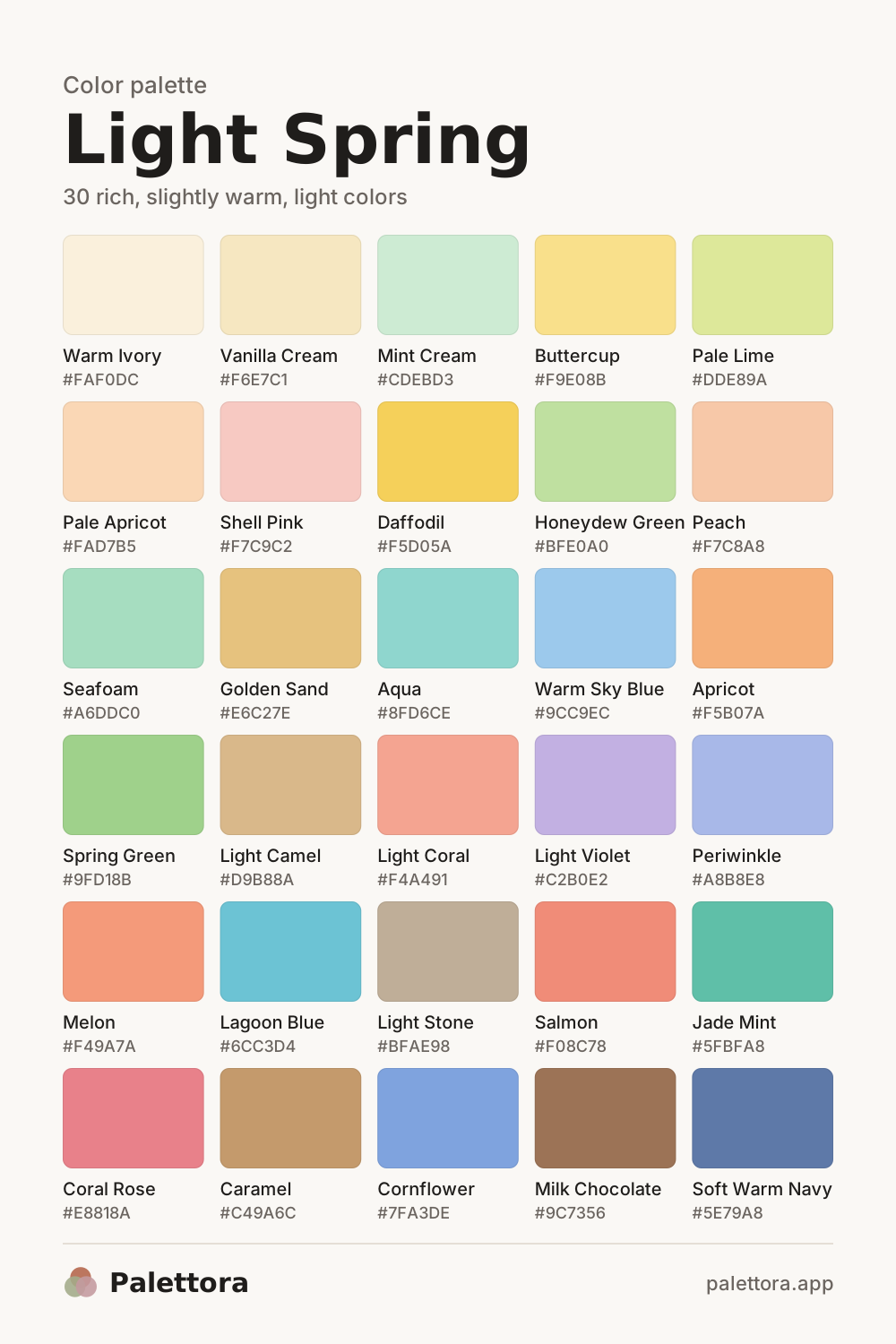
How to read this palette
Think of three dials. The hue dial on Light Spring points slightly toward yellow, so pinks drift peachy, greens look like new leaves and blues carry a touch of green. The value dial is turned up high: most colors sit between pastel and mid-tone. The chroma dial sits in the middle, so colors look clean and fresh rather than either dusty or neon.
Warm ivory and vanilla cream are the palest shades and take the place of stark white. At the deep end you have milk chocolate and a soft warm navy, which stand in for black and charcoal. Your liveliest accents are light coral, salmon, daffodil and lagoon blue.
Picture a seaside postcard in morning light. If a color would look at home there, it probably flatters you. If it belongs in a forest at dusk, it is likely too heavy.
What is Light Spring?
Light Spring is a pale, gently warm season with a fresh, sunlit look. Peach, buttercup, aqua and periwinkle suit you, while dark, heavy or dusty colors weigh your face down.
- Skin: fair to light-medium, often ivory, peach or light golden-beige, sometimes with freckles. It can flush a warm pink in the sun.
- Hair: golden, strawberry or honey blonde, or light golden brown.
- Eyes: clear light blue, aqua, blue-green, soft green or light hazel with golden flecks.
- Contrast: low to low-medium. Your eyes may be the clearest feature, but nothing about your coloring looks dark or dramatic.
- Black and burgundy make your face look shadowed, while pale warm colors make your skin look rested.
A quick self-test
Do the paper test. Stand by a window in daylight, makeup off, and hold a sheet of bright white paper under your chin, then a sheet of cream paper. If the cream makes your skin look smoother and the white makes it look slightly grey or ruddy, you lean Light Spring. If the white looks cleaner on you, check Light Summer.
Best Light Spring neutrals
Keep your basics light to middle in depth. Warm ivory and ecru replace white shirts. Light camel and light stone make easy trousers and coats, and soft warm navy gives you a dark anchor without the weight of black.
Colors Light Spring should avoid
- Jet Black#0A0A0A
- Charcoal#36383C
- Burgundy#6E1F2E
- Forest Green#2F4A33
- Dusty Mauve#9E8496
- Olive Drab#5B5A2E
- Icy Blue Grey#C3CCD6
- Fuchsia#C2185B
Three things go wrong with these shades. Black, charcoal, burgundy and forest green are far deeper than your coloring, so they create a hard frame that makes skin look pale and tired. Dusty mauve, olive drab and icy blue grey are muted or cold, and they flatten the glow in your skin. Fuchsia is cool and loud at once. Keep them for shoes or bags.
Metals and jewelry
- Light yellow gold
- Rose gold
- Champagne gold
- Polished brass
Pale, shiny warm metals suit you best. Light yellow gold, rose gold and champagne gold in a polished or softly satin finish catch the light the way your skin does. Heavy antique bronze and dark oxidised pieces look murky. Polished silver mixed with gold works better than gunmetal.
Light Spring makeup
Choose a light foundation with a peach or golden-neutral base. Test it on your jaw by a window; a shade that is too pink looks flushed, and one that is too yellow looks sallow. Sheer, dewy textures beat heavy matte.
- Peach Nude#E8A88E
- Light Coral#F08C7A
- Warm Pink#E88A93
- Apricot Gloss#F2A678
- Salmon Rose#D9776F
- Peach#F7B79A
- Soft Coral#F4A08C
- Warm Petal Pink#EFA4A4
- Champagne#EAD7B7
- Light Bronze#C99A6B
- Soft Golden Brown#A87D58
- Aqua#8FD6CE
- Warm Grey Brown#8E7A68
Light Spring hair colors
Golden blonde
The most natural lift for Light Spring hair. Ask for a warm, buttery tone rather than ash.
Strawberry blonde
A pale copper-gold that brings out blue and green eyes. Keep it light and sheer.
Honey highlights
Thin honey pieces through light brown hair add brightness without a hard regrowth line.
Light golden brown
If you prefer to go darker, stop at a light brown with gold in it. Deeper browns raise your contrast too far.
Warm beige blonde
A soft choice as grey comes in, because it blends with silver strands.
Hair colors to avoid
- Dark brown, black or espresso, which make light skin look washed out next to them.
- Ash or platinum blonde with a blue or violet toner, which cools your skin and brings out redness.
- Deep burgundy or plum reds, which are both too dark and too cool for you.
Nail colors for Light Spring
Sheer and creamy polishes look best. For work, peach or a pale coral reads as a polished nude. In summer, aqua or buttercup on your toes is playful without clashing with anything in your wardrobe.
Light Spring clothing and outfit tips
- Wear your lightest colors closest to your face. A peach or aqua top with darker trousers keeps the brightness where people look.
- Swap black for soft warm navy and milk chocolate. A navy blazer over a warm ivory tee works anywhere a black one would.
- Choose light-reflecting fabrics such as cotton poplin, fine knits, linen and softly sheened silk.
- Keep outfits in two or three pale-to-mid shades. If you add a deeper color, keep it below the waist.
- Pick denim in a light or medium wash. Dark indigo jeans are fine, but pair them with a light top.
- If an outfit feels flat, add one clear accent: a salmon scarf, a daffodil bag or coral lipstick.
Outfit combinations
Peach and stone
PeachLight StoneWarm Ivory
A peach knit with light stone chinos and warm ivory sneakers. Easy for weekends and casual offices.
Seaside
AquaVanilla CreamLight Camel
An aqua linen shirt over vanilla cream shorts, with light camel sandals.
Navy without the gloom
Soft Warm NavyLight CoralEcru
Soft warm navy trousers, a light coral blouse and an ecru cardigan. Office-ready and fresh.
Garden party
Spring GreenButtercupWarm Ivory
A spring green dress with a buttercup cardigan and warm ivory flats.
Blue and gold
PeriwinkleGolden SandMilk Chocolate
A periwinkle sweater, golden sand skirt and milk chocolate ankle boots.
Coral evening
SalmonLight CamelShell Pink
A salmon slip dress with a light camel wrap and shell pink heels.
Lagoon weekend
Lagoon BlueCaramelMint Cream
A lagoon blue top, caramel jeans or a skirt, and a mint cream tote.
Build a small capsule wardrobe
- Begin with a light base (warm ivory or ecru), a middle base (light camel or light stone) and a darker base (soft warm navy or milk chocolate).
- Add tops in two accent colors, for example light coral and aqua. Both work with all three bases, so every piece matches.
- Get a trench or light coat in light camel or light stone. It sits over every color here without darkening your face.
- Keep shoes and bags in caramel, light camel or ivory leather, which look lighter and fresher on you than black.
Patterns and prints
Small florals
Seafoam and Warm Sky Blue on Warm Ivory
Fine stripes
Spring Green and Light Violet on Mint Cream
Gingham
Seafoam and Warm Sky Blue on Pale Lime
Polka dots
Spring Green and Light Violet on Shell Pink
- Choose prints where the colors are light and close together, such as peach on ivory or aqua on mint cream. Strong black-and-white graphics overpower you.
- Delicate motifs suit this season best: small florals, fine stripes, gingham, polka dots, shells and watercolour fruit.
- Keep the scale small to medium and the spacing airy, with plenty of light background showing.
- Breton stripes work in ecru and soft warm navy or in ivory and coral, not in black and white.
Accessories and natural materials
- Light natural materials: blond wood, straw, wicker, pale tan leather, mother-of-pearl and light shell.
- Glasses in honey, light tortoiseshell, clear peach or champagne gold. Thick black frames dominate your face.
- Stones such as aquamarine, peridot, rose quartz, citrine, moonstone and pale coral.
- Pastel silk scarves in salmon, aqua or periwinkle bring color to the face over neutral outfits.
How to tell Light Spring from Light Summer and Warm Spring
Light Spring vs Light Summer
- What you share
- Both are light first, with low contrast and pale hair, skin and eyes. Both look good in pastels and both look heavy in black.
- What differs
- Light Spring tilts warm, toward peach, buttercup and aqua. Light Summer tilts cool, toward powder blue, lavender and rose. Your pastels look sunny; theirs look misty.
- How to tell which you are
- Compare a peach and a cool baby-pink top in daylight. If peach gives your cheeks color and pink makes you look pale or blotchy, you are Light Spring. If pink looks fresher and peach looks orange, you are likely Light Summer.
- Colors to borrow from Light Summer
- Your coolest shades overlap with Light Summer. Periwinkle, light violet and shell pink are the closest you get to its powder blues and rose pinks, so wear them freely, but skip its greyer lavenders.
- PeriwinkleLight VioletShell Pink
Light Spring vs Warm Spring
- What you share
- Both are spring seasons with golden warmth, clear colors and a liking for coral, warm yellow and turquoise.
- What differs
- Warm Spring is warm first and can carry full tangerine, kelly green and golden yellow. Light Spring is light first, so the same colors need to be paler before they look natural on you.
- How to tell which you are
- Try a tangerine scarf and a pale apricot one. If tangerine looks right and the apricot fades away, try Warm Spring. If tangerine shouts and apricot glows, you are Light Spring.
- Colors to borrow from Warm Spring
- Warm Spring shares your sunny side. Daffodil, salmon and apricot are lighter versions of its golden yellow and tangerine. Its full-strength orange and kelly green are usually too strong for you.
- DaffodilSalmonApricot
Light Spring questions
Light Spring is warm-leaning but close to neutral. Lightness is its main trait, so the warmth is gentle: peach rather than orange, buttercup rather than mustard. That is why some cool pastels like periwinkle still work, while icy, blue-based colors usually do not.
Black is the hardest color for you near the face, because it is much darker than anything in your natural coloring. A black skirt, trousers or shoes are fine. For a jacket or top, try soft warm navy, milk chocolate or light stone instead.
Light Spring usually goes with fair to light-medium skin. If your skin is golden olive but your hair and eyes are light, the clearer mid-tones help most. Try salmon, jade mint, lagoon blue and caramel, and keep the palest shades away from your face.
Warm beige blonde and soft honey highlights blend with grey best. Avoid dark box dyes, which create a harsh regrowth line. If you prefer to let grey grow in, keep warm ivory and peach near your face so your skin still looks warm against silver hair.
Yes, as long as it is a softer, slightly warm navy rather than an inky one. Soft warm navy works for coats, trousers and suits. Pair it with a light top such as warm ivory, peach or aqua so the darkest color is not right under your chin.
Not sure you are Light Spring? The quiz scores warmth, depth and clarity separately and also shows your runner-up season.
Take the color quizRelated seasons
- Light SummerNeighbour season: Light Summer is a pale, cool-leaning season with an airy, delicate feel.
- Warm SpringNeighbour season: Warm Spring is the most golden of the spring seasons, with clear, sunny, medium-light colors.
- Bright SpringAlso in the spring family.
- All 12 seasonsCompare every palette side by side.