Color season · Autumn family
Deep (Dark) Autumn Color Palette
Deep Autumn, also known as Dark Autumn, is a deep, warm-leaning color season with high contrast and rich, saturated earth tones. The deep autumn color palette runs from espresso, burgundy and aubergine through forest green, deep teal and bronze. Depth is the leading trait; warmth follows, but only gently, so a few cool-edged shades still work.
Your coloring can carry dark colors that swamp most people. Below are 30 shades with hex codes, the neutrals that replace black, makeup and hair advice, outfit formulas, and how to tell Deep Autumn apart from Deep Winter and Warm Autumn.
- Undertone
- Neutral-warm
- Depth
- Deep
- Chroma
- Medium
- Contrast
- High
The Deep Autumn color palette, color by color
Tap any swatch to copy its hex code, or download the full palette as an image for your phone.
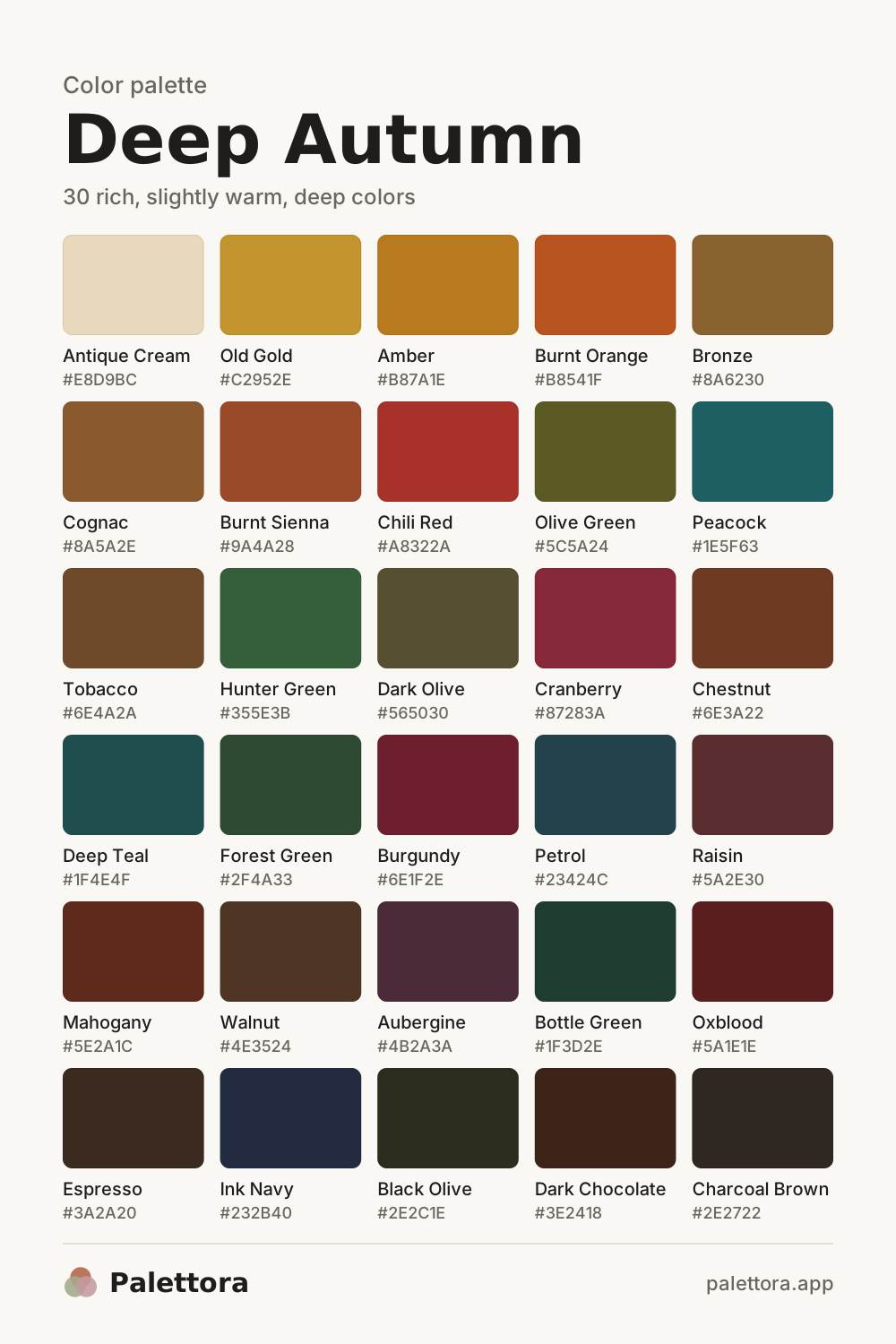
How to read this palette
Start with value, because that is what defines this season. Most of the 30 colors sit in the dark third of the scale: mahogany, oxblood, bottle green, petrol and walnut. Only antique cream, old gold and amber climb into the lighter range, and they work as highlights rather than bases.
Hue leans warm without being fully golden. Your reds are brick, chili and burgundy; your greens are forest, hunter and olive; your browns have a red or bronze cast. Because Deep Winter sits next door, cooler darks such as aubergine and ink navy also belong here.
Chroma is medium to rich. These shades have body and saturation, like spices, polished wood and jewel-toned velvet. They are never dusty, and never neon. If a color looks like it could be the lining of an old leather armchair, it is probably yours.
What is Deep Autumn?
Deep Autumn is the darkest and richest of the autumns. Burgundy, forest green, bronze, deep teal and espresso give your features definition. Pale, chalky or icy colors leave you looking flat.
- Skin: warm beige, golden olive, bronze, caramel, chestnut or deep brown with warm or neutral undertones.
- Hair: dark brown, deep chestnut, dark auburn, espresso or soft black, often with red or bronze glints in sunlight.
- Eyes: dark brown, black-brown, deep hazel, dark olive or topaz, usually with strong definition against the white of the eye.
- Contrast: medium-high to high. Dark hair and eyes stand out clearly against the skin, even when the skin is also deep.
- Light pastels make your face look grey and your features look smudged.
A quick self-test
In daylight, hold a dark espresso brown and a light camel fabric under your chin, one at a time. If espresso makes your jaw and eyes look sharper while camel looks faint, you are probably a deep season. Then compare burgundy with true black. If burgundy looks warmer and kinder, Deep Autumn fits better than Deep Winter.
Best Deep Autumn neutrals
Espresso, charcoal brown and black olive do everything black does, with more warmth. Ink navy is your cool-leaning dark for tailoring. For a light neutral, antique cream beats bright white. Cognac and tobacco cover the middle ground for coats, bags and boots.
Colors Deep Autumn should avoid
- Optic White#FFFFFF
- Baby Blue#BFD8F0
- Pastel Pink#F4C2D7
- Icy Lavender#DCD3EE
- Dusty Rose#C49A9F
- Silver Grey#C0C4CC
- Hot Pink#E6287A
Your problem colors are the light, the cool and the chalky. Baby blue, pastel pink and icy lavender are too pale and too cool, so your face looks grey beside them. Dusty rose and silver grey are too faded to match your depth. Hot pink is cool and loud at once. Optic white is a contrast clash: try antique cream instead.
Metals and jewelry
- Antique gold
- Bronze
- Copper
- Gunmetal
- Brass
Deep, old-looking metals suit you best. Antique gold, bronze and copper echo your browns. Gunmetal works when you wear the cooler shades, like ink navy or aubergine. Polished or hammered finishes both work; delicate rose gold and pale platinum tend to disappear on you.
Deep Autumn makeup
Choose neutral or golden undertones, and do not go too light: Deep Autumns often buy a shade paler than they need. Check the match on your neck and chest in daylight, not just your cheek.
- Brick#8E3A28
- Chili#A8322A
- Deep Berry#7A2635
- Mahogany Brown#5E2A1C
- Spiced Plum#5A2E35
- Burnt Sienna#A65A3A
- Deep Terracotta#9E4E36
- Bronze Rose#8E5040
- Bronze#8A6230
- Aubergine#4B2A3A
- Forest#2F4A33
- Deep Teal#1F4E4F
- Espresso#3A2A20
Deep Autumn hair colors
Deep chestnut
Rich brown with a red glow. It deepens your natural color without adding a stark edge.
Dark chocolate brown
A soft-black alternative that keeps contrast high while staying warm.
Mahogany
A red-brown that picks up burgundy and oxblood in the palette. Best on medium to deep skin.
Bronze or toffee balayage
Ribbons of bronze through dark brown add movement. Keep them a few shades from the base, not blonde.
Dark auburn
Works if you have reddish glints already. Choose a brown-based red rather than a bright copper.
Hair colors to avoid
- Platinum, ash or pale golden blonde, which drop your contrast and wash out your features.
- Blue-black dye, which looks harsh against warm skin and emphasises any redness.
- Pinkish or rose-gold tones, which fight the warmth in your skin.
Nail colors for Deep Autumn
Dark shades are where you shine. Oxblood and espresso are classic on short square nails. For something different, try forest green in a high-gloss finish or a bronze metallic for evenings.
Deep Autumn clothing and outfit tips
- Anchor every outfit with one dark color. Espresso trousers, a burgundy dress or a forest green coat gives your look the weight your features need.
- Use contrast on purpose. Antique cream under a walnut jacket or old gold against bottle green echoes the contrast in your own face.
- Pick saturated darks over faded ones. Washed-out khaki and grey-beige make you look tired; dark olive and cognac do not.
- Rich surfaces suit you: velvet, leather, heavy silk, wool crepe and corduroy look better on you than flimsy pastels or sheer chiffon.
- For denim, a dark rinse with no fading is your best option. Pair it with cognac boots and an amber or rust knit.
- If you work in a dark-suit office, swap black for charcoal brown or ink navy, and add a jewel-toned shirt such as peacock or cranberry.
Outfit combinations
Boardroom
Ink NavyAntique CreamCognac
An ink navy suit, antique cream shirt and cognac belt and shoes.
Forest evening
Forest GreenOld GoldEspresso
A forest green velvet blazer with old gold jewelry and espresso trousers.
Wine and walnut
BurgundyWalnutBronze
A burgundy knit over walnut trousers, finished with bronze hoops.
Peacock pop
PeacockChestnutAntique Cream
A peacock silk blouse, chestnut leather skirt and antique cream coat.
Bonfire
Burnt OrangeDark OliveDark Chocolate
A burnt orange sweater with dark olive cargo trousers and dark chocolate boots.
Jewel night out
AubergineAmberCharcoal Brown
An aubergine slip dress, amber earrings and a charcoal brown leather jacket.
Weekend layers
Hunter GreenTobaccoBlack Olive
A hunter green flannel shirt, tobacco suede jacket and black olive jeans.
Build a small capsule wardrobe
- Pick one dark base (espresso or charcoal brown), one mid base (cognac or tobacco) and one light base (antique cream).
- Add two or three jewel-earth accents, for example burgundy, forest green and peacock. They mix with each other as easily as with the bases.
- Make your coat a dark one. A walnut or espresso wool coat works with every accent here.
- Keep antique cream for shirts and knits near your face, where it lifts the darker pieces without looking stark.
Patterns and prints
Leaf print
Tobacco and Mahogany on Antique Cream
Plaid
Deep Teal and Bottle Green on Amber
Geometric
Tobacco and Ink Navy on Bronze
Small florals
Deep Teal and Charcoal Brown on Burnt Sienna
- Go for medium to bold scale with clear contrast between colors. A cream-and-forest botanical print works; a faded watercolour does not.
- Rich, traditional motifs suit you: paisley, damask, tapestry florals, Fair Isle, dark tartan and tortoiseshell.
- Animal prints look best in dark versions, such as chocolate leopard or bronze snakeskin, rather than pale beige ones.
- Avoid small, faint ditsy prints on pale grounds. They disappear against your coloring.
Accessories and natural materials
- Dark leather and suede in espresso, oxblood and cognac. A structured bag in one of these replaces a black one.
- Glasses frames in dark tortoiseshell, deep brown, burgundy or dark olive acetate.
- Stones with depth: garnet, smoky quartz, tiger's eye, malachite, deep amber and onyx set in antique gold.
- Wooden bangles, horn buttons, leather cuffs and woven wool scarves in dark plaids.
How to tell Deep Autumn from Deep Winter and Warm Autumn
Deep Autumn vs Deep Winter
- What you share
- Both are deep seasons with high contrast, dark hair and eyes, and a taste for strong colors. Burgundy, emerald-leaning greens and dark navy suit both.
- What differs
- Deep Winter leans cool and bright: true black, icy white, pure red and silver. Deep Autumn leans warm and earthy: espresso, brick, bronze and antique gold. Black can look severe on you, while warm browns can look muddy on a Deep Winter.
- How to tell which you are
- Compare a jet black top with an espresso one, and silver with antique gold. If black and silver look crisp, try Deep Winter. If espresso and gold make your skin look healthier, stay with Deep Autumn.
- Colors to borrow from Deep Winter
- Deep Winter shares your depth, so its darks are within reach as long as they keep some warmth. Ink navy, aubergine and cranberry all sit on that border. Skip pure black and icy white.
- Ink NavyAubergineCranberry
Deep Autumn vs Warm Autumn
- What you share
- Both are autumns with earthy colors and gold jewelry. Rust, olive, teal and chocolate work for both of you.
- What differs
- Warm Autumn is golden first and only medium in depth, so it wears mustard and camel easily. Deep Autumn is dark first, with higher contrast. Its best colors are darker and slightly cooler, like burgundy and aubergine.
- How to tell which you are
- Hold up mustard and then burgundy. If burgundy makes your features look sharp and mustard looks pale, you are Deep Autumn. If mustard makes you glow and burgundy looks heavy, try Warm Autumn.
- Colors to borrow from Warm Autumn
- The lighter, golden side of your palette overlaps with Warm Autumn. Burnt orange, old gold and amber are shared, so wear them as highlights against your darker bases.
- Burnt OrangeOld GoldAmber
Deep Autumn questions
Yes. Dark Autumn and Deep Autumn are two labels for one season. Both describe the autumn whose main trait is depth, with warmth second. You may also see Deep Autumn listed as a bridge between autumn and winter, which is why some cooler darks appear in its palette.
We don't list deep autumn celebrities. Season labels for famous people are opinions, and photos are edited and lit in ways that change color. A quiz plus a daylight fabric test will tell you more about your own season than comparing yourself to a picture.
You can wear more black than most autumns, but it is still not your best dark. Next to the face, espresso, charcoal brown or black olive look richer and less severe. If you love black, wear it with gold jewelry and a warm lip to bring the warmth back.
Often, yes. Deep skin with warm or neutral undertones is common in this season. Burgundy, burnt orange, old gold and peacock look rich against deep skin. Check undertone first, though: if you glow in jewel tones and silver, look at Deep Winter too.
In 12 seasons, Deep Autumn is a single type sitting between Warm Autumn and Deep Winter. Some 16-season systems split that area into a warmer and a darker version, or add a separate 'dark' type. The colors barely change; only the label and the boundaries move.
Charcoal brown, ink navy, espresso and dark olive give you the authority of a black suit with more warmth. Add antique cream shirts and one accent, such as cranberry or peacock. Cognac leather shoes and bags tie it together.
Not sure you are Deep Autumn? The quiz scores warmth, depth and clarity separately and also shows your runner-up season.
Take the color quiz