Face shape guide
Rectangle Face Shape
A rectangle face shape is much longer than it is wide, with forehead, cheekbones and jaw at nearly the same width. The jaw turns a sharp corner below each ear, and the chin is broad and flat across the bottom.
Think of it as a square face drawn taller. A rectangular face has two traits to work with: length and hard corners. Good styling handles both, adding width at the sides and some curve near the jaw.
Many sites use oblong and rectangle as one shape. Here they are separate. Rectangle has the angular jaw; oblong has the same length with a soft, rounded jaw. Run your fingers under your ears to decide, because the advice differs.
How to tell if you have a rectangle face shape
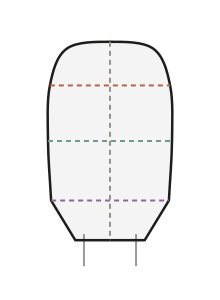
- Length vs width
- Much longer than wide
- Widest part
- All similar: forehead, cheekbones and jaw nearly equal
- Jawline
- Sharp and angular, with a defined corner under the ear
- Chin
- Square and flat
- Measure from hairline to chin and across the cheekbones. A rectangle face is clearly long: the length is much greater than the width.
- Compare three widths: across the temples, across the cheekbones, and from jaw corner to jaw corner. All three land close together, giving straight vertical sides.
- Feel for the jaw angle. Press under each earlobe and trace forward; on a rectangle you meet a firm corner, then a nearly straight line to the chin.
- In a front photo, the chin looks wide and flat at the base rather than tapering to a point or curving under.
Rectangle vs oblong
Same long, straight-sided outline. The jaw decides it: rectangle has hard corners and a flat chin, oblong curves smoothly into a rounded chin.
Rectangle vs square
Square shares the angled jaw and flat chin but is about as wide as it is long. If your face clearly runs long, you are rectangle.
Best hairstyles for a rectangle face
- A chin-to-shoulder bob with soft, bent waves at the jaw puts width and curve exactly where your corners sit.
- Wispy, eyebrow-grazing bangs shorten the forehead and cut the overall length; keep them feathered, not blunt.
- Curtain bangs that sweep outward over the temples widen the upper face while hiding a high hairline.
- Layered shoulder-length hair with volume at the cheekbones and ends flicked outward breaks the straight sides.
- Loose curls or a round brush blowout add width at the sides; keep the crown fairly flat.
- A low, loose bun with face-framing tendrils draws attention to the cheeks instead of the jaw.
Hairstyles to avoid
- Long, straight, one-length hair, which adds vertical lines and points to the jaw corners.
- High ponytails and volume piled on top, which make the face look even taller.
- Severe middle parts with slicked sides, which expose the straight outline.
- Blunt chin-length bobs with sharp corners, which repeat the jaw angle.
Men's haircuts
- A classic short back and sides with a soft side part keeps height low; leave a little fullness at the temples.
- A textured crop with a short fringe falling forward reduces visible forehead.
- A medium-length, slightly messy cut with natural movement at the sides adds width.
- Skip tall quiffs and pompadours, which add the length you already have.
Beard styles
- A short, full beard kept fuller on the cheeks than the chin widens the lower face.
- Round off the corners at the jaw when trimming, so the beard softens the angle rather than outlining it.
- Keep chin length short; a long or pointed beard adds length.
- Light stubble can work, but avoid a sharp, high-contrast line along the jaw.
Glasses for a rectangle face shape
- Oversized square
- Aviator
- Round
By the contrast rule, rounded frames soften angular faces, so curves are your first choice. Pick deep frames that break up the length and reach the edges of the face. Set the top rim along your brow line so the lenses cover the middle third.
- Round or oval frames, which add curves to an angular face.
- Deep frames with plenty of vertical height, which shorten the visible face.
- Oversized frames, wide enough to reach the temples.
- Frames with thick or decorated temple arms, which add width at the sides.
Frames to avoid
- Narrow, shallow rectangular frames, which echo the long straight lines.
- Small frames that sit well inside the face width.
Makeup and contouring
- Keep brows fairly straight with only a soft arch; a high, peaked brow lengthens the face.
- Smudged, horizontal eyeliner stretched outward adds width across the eye area.
- Choose a cream or satin blush and place it on the apples, blended out toward the ears, not up.
- Use a fuller lip shape with soft edges to balance the strong chin.
Where to contour, highlight and blush
- Blur the jaw corners: press matte contour onto each angle under the ear and blend it into the neck to round the corner off.
- Shade along the top of the forehead at the hairline to shorten the face from above.
- Add a thin band of contour under the chin to shorten it from below.
- Highlight across the cheekbones in a horizontal line toward the ears, not down the nose.
Rectangle face shape questions
A long face with roughly equal widths and a squared, angular jaw is a rectangle. If the length is similar but the jaw curves smoothly into a rounded chin, it is oblong. If the jaw is angular but the face is about as wide as it is long, it is square.
You need three checks: is the length much greater than the width, are the forehead, cheeks and jaw close in width, and is there a corner under each ear? Three yeses point to rectangle. Most faces mix two shapes, and weight gain or loss can shift a close result toward square or oblong.
Our free face shape tool measures your photo in the browser and never uploads it. It compares length to width and checks the jaw angle, then shows how close the other shapes were. Use a well-lit, straight-on photo with your hair pulled back for the most reliable result.
Bangs do the most work, since they hide part of the forehead. Pair them with width at the cheeks and jaw, such as a wavy bob or layers that flip outward. Avoid height at the crown.
Not sure your face is rectangle? Measure it from a photo in your browser, or answer five quick questions.
Find my face shapeOther face shapes
- Oblong faceOften confused with this shape.
- Square faceOften confused with this shape.
- Oval faceSlightly longer than it is wide, with cheekbones as the widest point and a softly curved jaw. Most cuts and frames work, so you can choose by mood and hair texture.
- Round faceAbout as long as it is wide, with full cheeks and a jaw that curves without corners. Height on top and vertical lines add length.
- Heart faceA heart face is widest at the forehead and narrows to a slim jaw and pointed chin. You look best when hair and frames add weight to the lower half and keep the top quiet.
- Face shape chartAll eight shapes side by side.