Color season · Autumn family
Soft (Muted) Autumn Color Palette
The soft autumn color palette is made of warm, muted, medium-depth colors: think sage, camel, dusty coral, mushroom and soft teal. Soft Autumn is the gentlest of the three autumn seasons. Its main trait is softness, so every color is slightly greyed, and warmth comes second.
If your features blend together rather than stand out, and gold looks more natural on you than silver, this is likely your season. Below you'll find all 30 colors with hex codes, plus makeup, hair, outfits and how to tell Soft Autumn from its two closest neighbours.
- Undertone
- Neutral-warm
- Depth
- Medium
- Chroma
- Soft (muted)
- Contrast
- Low
The Soft Autumn color palette, color by color
Tap any swatch to copy its hex code, or download the full palette as an image for your phone.
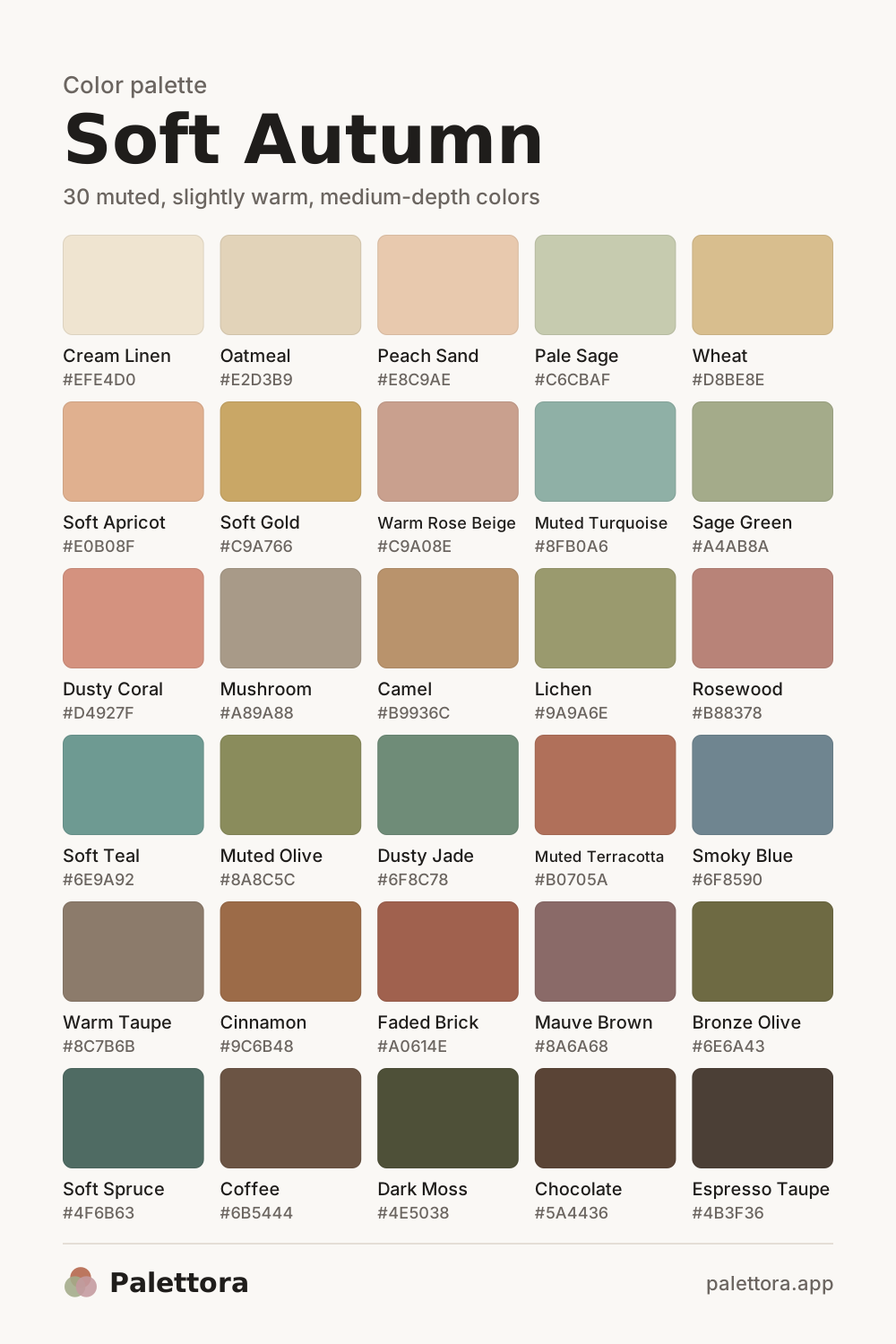
How to read this palette
Every color has three dimensions. In hue, Soft Autumn leans warm, but only slightly: its greens are olive and sage rather than kelly, its pinks lean toward coral and rose-brown. In value, it sits in the middle, with nothing as pale as icy pastel and nothing as dark as black. In chroma, it is low. That greyed, misty quality is what makes the palette look calm.
The lightest colors here are cream linen and oatmeal, which replace white. The darkest are chocolate, dark moss and espresso taupe, which replace black. Between them, the strongest accents are dusty coral, soft teal and muted terracotta. Use those near your face when you want color that still looks effortless.
A useful rule: if a color looks like it was faded by the sun or dusted with clay, it probably belongs to you. If it looks freshly dyed, it probably does not.
What is Soft Autumn?
Soft Autumn is a gentle, slightly warm season. Your best colors look as if they were mixed with a little grey: sage, camel, dusty coral and soft teal. Bright, icy or very dark shades tend to sit on top of you instead of blending in.
- Skin: neutral to slightly warm, often beige, olive-beige or golden-beige. It rarely flushes bright pink.
- Hair: dark ash blonde, light to medium golden brown, mousy brown or soft auburn. The color is muted rather than shiny copper or blue-black.
- Eyes: soft hazel, green-hazel, olive green, warm grey-green or light brown, often with a blended iris pattern rather than a sharp ring.
- Contrast: low. From a few steps back, your hair, skin and eyes read as one harmonious, medium-toned picture.
- In photos, bright colors look like they are wearing you, while muted shades make your skin look smoother.
A quick self-test
Try the grey test. In daylight, with no makeup, hold a mid-grey scarf under your chin and look at your eyes. If they turn greyish or blue-grey, you may be Soft Summer. If they stay clearly green, hazel or warm brown, Soft Autumn is the better fit.
Best Soft Autumn neutrals
Build your wardrobe base from these instead of black, white and navy. Oatmeal and soft ivory work as your white; chocolate and coffee work as your black. Camel and mushroom are the easiest coat and knitwear colors you will ever own.
Colors Soft Autumn should avoid
- Optic White#FFFFFF
- Jet Black#0A0A0A
- Icy Pink#F3D3E3
- Lemon Yellow#FFF44F
- Neon Fuchsia#FF1493
- Electric Blue#1E4FD8
- Cool Silver Grey#C0C4CC
- Royal Purple#5B2A86
These fail for two different reasons. Icy pastels and cool silver grey are too cool and make your skin look sallow. Neon, electric and saturated jewel shades are too strong for your softness, so the color arrives before you do. Pure black and optic white create a contrast your features do not have. If you love one of these, wear it away from your face, as trousers, shoes or a bag.
Metals and jewelry
- Brushed gold
- Antique brass
- Bronze
- Rose gold
- Copper
Warm metals win, but finish matters as much as color. Choose matte, brushed, hammered or antique finishes over mirror-polished ones, which can look harsh next to soft coloring. Mixed gold and bronze pieces work well. If you prefer silver, look for pewter or oxidised silver rather than bright platinum.
Soft Autumn makeup
Look for foundations labelled neutral or golden-beige rather than pink or rosy. Swatch three shades along your jawline in daylight; the right one disappears instead of looking grey or orange.
- Muted Peach#C98B73
- Terracotta Nude#B5735A
- Rose Brown#A86F64
- Warm Mauve#9A6F6A
- Brick Rose#9C5A4E
- Soft Peach#E0A58C
- Apricot Rose#D59783
- Dusty Terracotta#C2826B
- Warm Rose#C48C84
- Taupe#8C7B6B
- Soft Bronze#8C6A45
- Moss#7A7D52
- Soft Teal#6E9A92
- Olive#6E6A43
- Coffee#5A4436
Soft Autumn hair colors
Soft golden brown
The safest choice. It adds warmth without the brassiness of a strong copper.
Honey or caramel balayage
Fine, blended ribbons through light brown hair brighten your face without raising contrast.
Muted auburn
A brown-based red, closer to cinnamon than to copper. Keep it soft rather than glossy.
Bronde
A brown-blonde blend suits dark ash blonde hair and grows out gently.
Warm mushroom brown
A greyed brown with a touch of gold; a good option as grey hair starts to come in.
Hair colors to avoid
- Blue-black or jet black, which adds harsh contrast and drains your skin.
- Platinum, icy or silver blonde, which pulls your skin toward grey.
- Bright copper, cherry or burgundy-violet reds, which overpower soft features.
Nail colors for Soft Autumn
Creamy, low-shine finishes suit you more than glitter or chrome. For an everyday neutral, rose brown or warm taupe looks polished on every skin depth.
Soft Autumn clothing and outfit tips
- Keep contrast low. Pair colors that are close in depth, such as sage with oatmeal, rather than a dark color against a very light one.
- Wear your strongest accents (dusty coral, soft teal, muted terracotta) at the neckline, and push deeper browns and olives to the lower half.
- Swap your white T-shirt for soft ivory or oatmeal, and your black blazer for chocolate or coffee.
- Choose fabrics with a soft surface: suede, brushed cotton, cashmere, washed linen and matte silk. High-shine satin or patent can look harsh on you.
- Tonal outfits are your shortcut. Three shades of the same family, like camel, wheat and cream linen, always look considered.
- Denim works best in a mid wash with a grey or slightly green cast, not dark indigo or bright blue.
Outfit combinations
Weekend neutral
OatmealCamelChocolate
An oatmeal knit, camel trousers and chocolate loafers. Quiet, warm and easy to repeat.
Sage and coral
Sage GreenDusty CoralCream Linen
A sage shirt with a dusty coral scarf over cream linen trousers. The coral brings warmth to your face.
Office soft teal
Soft TealWarm TaupeSoft Ivory
A soft teal blouse under a warm taupe suit, with a soft ivory camisole as an alternative.
Olive layers
Muted OlivePeach SandCoffee
An olive utility jacket over a peach sand top with coffee jeans or boots.
Evening terracotta
Muted TerracottaBronze OliveSoft Gold
A terracotta wrap dress with bronze-olive shoes and soft gold jewelry.
Misty blue
Smoky BlueMushroomOatmeal
Smoky blue denim, a mushroom sweater and oatmeal sneakers. A rare blue that works for you.
Autumn tonal
CinnamonWheatEspresso Taupe
A cinnamon cardigan with wheat trousers and espresso taupe boots.
Build a small capsule wardrobe
- Start with three neutrals: one light (oatmeal or soft ivory), one middle (camel or mushroom) and one dark (chocolate or coffee).
- Add two signature colors you love from the palette, such as sage and dusty coral. Every top in those colors will work with every neutral.
- Buy outerwear in your middle neutral. A camel or mushroom coat works over everything in this palette.
- Keep the darkest neutrals for shoes, belts and trousers, and the lightest near your face.
Patterns and prints
Watercolour wash
Dusty Coral and Lichen on Cream Linen
Leaf print
Soft Teal and Muted Terracotta on Peach Sand
Tonal stripes
Dusty Coral and Lichen on Wheat
Herringbone
Soft Teal and Muted Terracotta on Soft Gold
- Choose low-contrast prints, where the colors are close in depth. A sage-on-oatmeal paisley works; a black-and-white houndstooth does not.
- Organic motifs suit the season: leaves, small florals, watercolour washes, animal prints in camel and brown, and faded ikat.
- Keep the scale small to medium. Very large, graphic prints can overpower a low-contrast face.
- Blurred edges beat crisp ones. Heathered knits, tweed and melange fabrics are patterns in their own right.
Accessories and natural materials
- Natural materials echo the palette: tortoiseshell, wood, horn, cognac or tan leather, raffia and jute.
- Glasses in soft tortoiseshell, olive, bronze or warm taupe frames, rather than black or clear crystal.
- Stones like smoky quartz, peridot, citrine in a muted cut, jade and unpolished amber.
- Bags and belts in cognac, coffee or olive suede tie an outfit together better than black leather.
How to tell Soft Autumn from Soft Summer and Warm Autumn
Soft Autumn vs Soft Summer
- What you share
- Both seasons are soft first, with low contrast and greyed colors. Both look good in sage, taupe and dusty rose, and both are overpowered by neon and black.
- What differs
- Soft Summer leans cool, so its palette tilts toward blue-grey, mauve and rose. Soft Autumn leans warm, toward olive, camel and coral. Silver looks natural on Soft Summer; gold looks natural on you.
- How to tell which you are
- Hold a dusty coral and a dusty rose fabric to your face in daylight. If coral makes your skin look clearer, you are Soft Autumn. If rose wins and coral looks orange on you, try Soft Summer.
- Colors to borrow from Soft Summer
- From Soft Summer you can borrow the muted blues and mauves, as long as they keep a hint of warmth. Smoky blue, mushroom and mauve brown sit on the border between the two seasons.
- Smoky BlueMushroomMauve Brown
Soft Autumn vs Warm Autumn
- What you share
- Both are autumn seasons, with golden undertones, earthy colors and gold jewelry. Camel, olive and terracotta suit both.
- What differs
- Warm Autumn is warm first, so it can take saturated rust, pumpkin and mustard. Soft Autumn is soft first, and those same colors look heavy on you unless they are dusted down.
- How to tell which you are
- Compare a bright rust and a muted terracotta. If the rust lights you up, you are likely Warm Autumn. If it looks loud and the terracotta looks right, stay with Soft Autumn.
- Colors to borrow from Warm Autumn
- From Warm Autumn you can borrow the gentler spices: muted terracotta, cinnamon and soft gold. Leave out its stronger rust, pumpkin and mustard, which are too saturated for you.
- Muted TerracottaCinnamonSoft Gold
Soft Autumn questions
Yes. They are two names for the same season. Some analysts say Muted Autumn, others say Soft Autumn, and a few use Gentle or Dusty. In every case the season is soft first and warm second.
Not near the face. Black is far darker and sharper than anything in your coloring, so it tends to cast shadows under the eyes. Use chocolate, coffee or espresso taupe instead. Black shoes or a black bag are fine.
The 12-season system splits each of the four seasons into three, based on the strongest trait. Some analysts go further and add in-between types, giving 16. Soft Autumn exists in both. In a 16-season system you might see it split into a softer and a warmer version, so check the description, not just the name.
Your undertone stays the same, so you remain soft and slightly warm. Grey hair does lower your contrast and cool your overall look, so many Soft Autumns find the cooler end of the palette, like smoky blue and mushroom, works better over time.
We don't list Soft Autumn celebrities, on purpose. Celebrity seasons are guesses made from photos, where lighting, makeup and hair dye hide your real coloring. Matching yourself to a famous face is less reliable than testing coral against rose at your own window.
Muted, warm mid-tones: terracotta nude, rose brown, warm mauve and brick rose. Sheer or satin finishes look more natural on you than high-shine gloss or a flat bright red.
Not sure you are Soft Autumn? The quiz scores warmth, depth and clarity separately and also shows your runner-up season.
Take the color quiz