Face shape guide
Oblong Face Shape
An oblong face shape is much longer than it is wide, with a forehead, cheeks and jaw of similar width and a soft, curved jawline. The chin is rounded, and the cheeks run fairly straight down instead of curving out.
Oblong is the most common name for a long face shape, and it is often lumped together with rectangle. On this site we separate them by the jaw. Yours curves; a rectangle's has hard corners. That changes the advice: you need width and a bit of structure, not softening.
How to tell if you have an oblong face shape
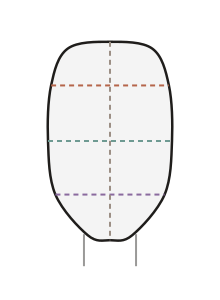
- Length vs width
- Much longer than wide
- Widest part
- All similar, so the sides look straight
- Jawline
- Rounded and soft, with no corner
- Chin
- Rounded
- Measure hairline to chin, then cheekbone to cheekbone. On an oblong face the length clearly dominates, and the face reads as long at a glance.
- Hold a ruler vertically against each side of your face in the mirror. If temple, cheek and jaw all touch it at about the same point, your sides are straight.
- Trace your jaw from earlobe to chin. You should feel a gentle slope with no corner, ending in a rounded chin.
- Borderline cases are common. An oval face with slim cheeks can measure as oblong, and losing weight or the hollowing of the cheeks with age can tip you over the line.
Oblong vs rectangle
Both are long with straight sides. Rectangle has an angular jaw and a flat chin; yours slopes gently and ends in a curve.
Oblong vs oval
Oval is shorter and widest at the cheekbones, tapering toward the chin. Oblong keeps the same width from top to bottom.
Best hairstyles for an oblong face
- Full, blunt bangs that reach the brows take several centimeters off the visible length; this is the single most useful cut for you.
- A chin-length bob with texture through the ends adds horizontal width at the lower face, where yours is narrow.
- Big, bouncy blowouts or natural curls with volume at the ears widen the middle of the face.
- A collarbone-length lob with waves from cheekbone level down keeps length without a long, straight curtain.
- Side-parted hair with a sweeping fringe adds width across the forehead.
- Half-up styles with volume at the sides, not the crown, add structure without height.
Hairstyles to avoid
- Very long, sleek, straight hair, which draws a vertical line from top to bottom.
- Teased crowns, top knots and high ponytails, which stack on more length.
- Hair pulled tight to the head at the sides, which exposes the narrow width.
Men's haircuts
- A side-swept fringe or a short textured crop worn forward cuts the forehead length.
- Keep the sides at a medium length, a number 3 guard or longer, rather than a skin fade, so the head doesn't look narrow.
- A messy, mid-length cut with natural wave adds width at the temples.
- Avoid tall pompadours and spiky tops, which lengthen the face.
Beard styles
- A full beard with squared-off sides adds width and some structure to a soft, long jaw.
- Grow the cheek area fuller and keep the chin short and flat across the bottom.
- A chevron mustache paired with stubble breaks up the length with a horizontal line.
- Skip goatees and long chin beards, which add length below the face.
Glasses for an oblong face shape
- Oversized square
- Round
- Browline
Your jaw is soft, so frames with some angle supply contrast, but depth matters more than shape. Choose a frame that reaches the edges of your face and has generous height, with the top rim at your brow line or just above it. A thick or contrasting temple arm also adds width at the sides.
- Bold square or geometric frames, which give your soft jaw more definition.
- Deep frames, tall from top to bottom, that cover more of the middle of the face.
- Wide frames with decorative temples or a thick top bar to add horizontal emphasis.
- Low-bridge frames, which sit lower on the nose and shorten it visually.
Frames to avoid
- Small, narrow frames, which leave the face looking even longer.
- Rimless or very thin frames, which add no width.
- Shallow frames that sit as a thin line across the eyes.
Makeup and contouring
- Brush blush in a horizontal stroke across the apples and out toward the ears to make the face look wider.
- Keep brows long and fairly flat, extending slightly past the outer eye.
- Smoky eyes blended out to the sides, rather than up, add width at the middle of the face.
- Skip heavy nose contour, which makes the face look narrower.
Where to contour, highlight and blush
- Shade the forehead along the hairline and blend downward.
- Contour the very bottom of the chin to shorten the lower face.
- Leave the jaw unshaded: it is already narrow and soft, and contour there only slims it.
- Highlight the outer cheekbones and the sides of the forehead to bring width outward.
Oblong face shape questions
Pull your hair back, look straight into a mirror and compare length to width. If the face is clearly long, the sides look straight, and the jaw curves without any corner, you are oblong. If you find a sharp corner under the ear instead, you are rectangle.
Go for depth and width: tall frames reaching the edges of your face, ideally with bold temples or a thick top bar. Square and geometric shapes add structure to your soft jawline. Avoid small, narrow or rimless frames, which leave the face looking even longer.
Yes. There is no ranking of face shapes. Stylists sometimes call oval the balanced ideal, but that is only a reference point for choosing cuts and frames. A long face often photographs well in profile and suits dramatic fringes that wider faces cannot wear as easily.
It can look more oblong. Cheeks often lose fullness over time, which narrows the middle of the face, and weight loss has a similar effect. The bone structure has not changed. If you were borderline oval before, you may now find oblong advice works better.
Not sure your face is oblong? Measure it from a photo in your browser, or answer five quick questions.
Find my face shapeOther face shapes
- Rectangle faceOften confused with this shape.
- Oval faceOften confused with this shape.
- Round faceAbout as long as it is wide, with full cheeks and a jaw that curves without corners. Height on top and vertical lines add length.
- Square faceA square face is about as long as it is wide, with forehead, cheekbones and jaw all close in width and a strong, angular jawline. Soft movement and a little height keep those corners from boxing the face in.
- Heart faceA heart face is widest at the forehead and narrows to a slim jaw and pointed chin. You look best when hair and frames add weight to the lower half and keep the top quiet.
- Face shape chartAll eight shapes side by side.