Guide
Skin Colors: The Full Range and What Shapes Yours
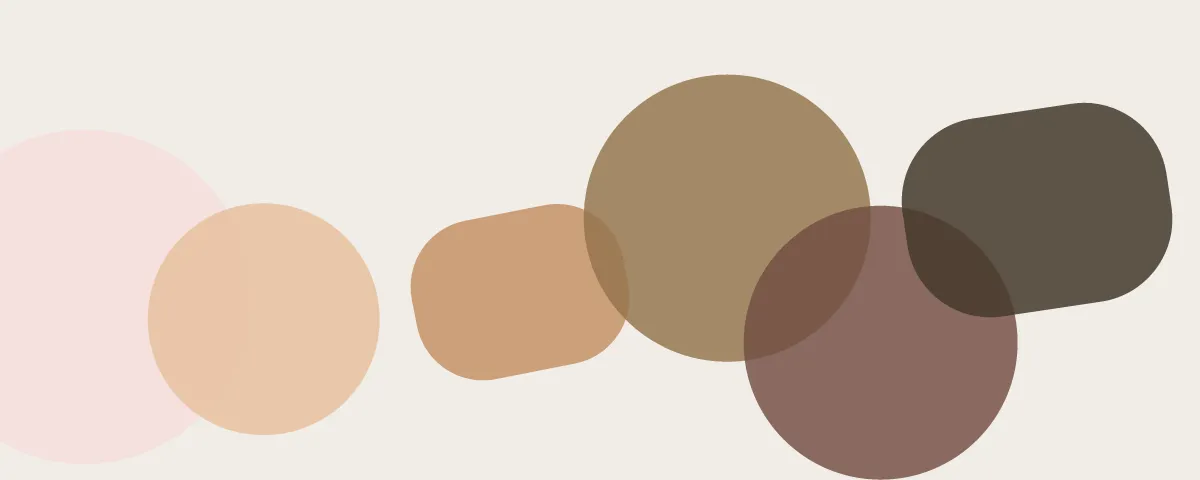
Human skin colors form one continuous range, from the palest ivory to the deepest brown, with no natural dividing lines. Every depth also carries an undertone: warm, cool, neutral or olive. There is no fixed number of skin colors. Charts like ours split the range into steps, eight depths by four undertones, simply so it is easier to describe and shop for.
The range of human skin colors
Look at the chart below as a gradient rather than a set of boxes. Each swatch is an average, and real people sit between them, across them, and sometimes in two at once.
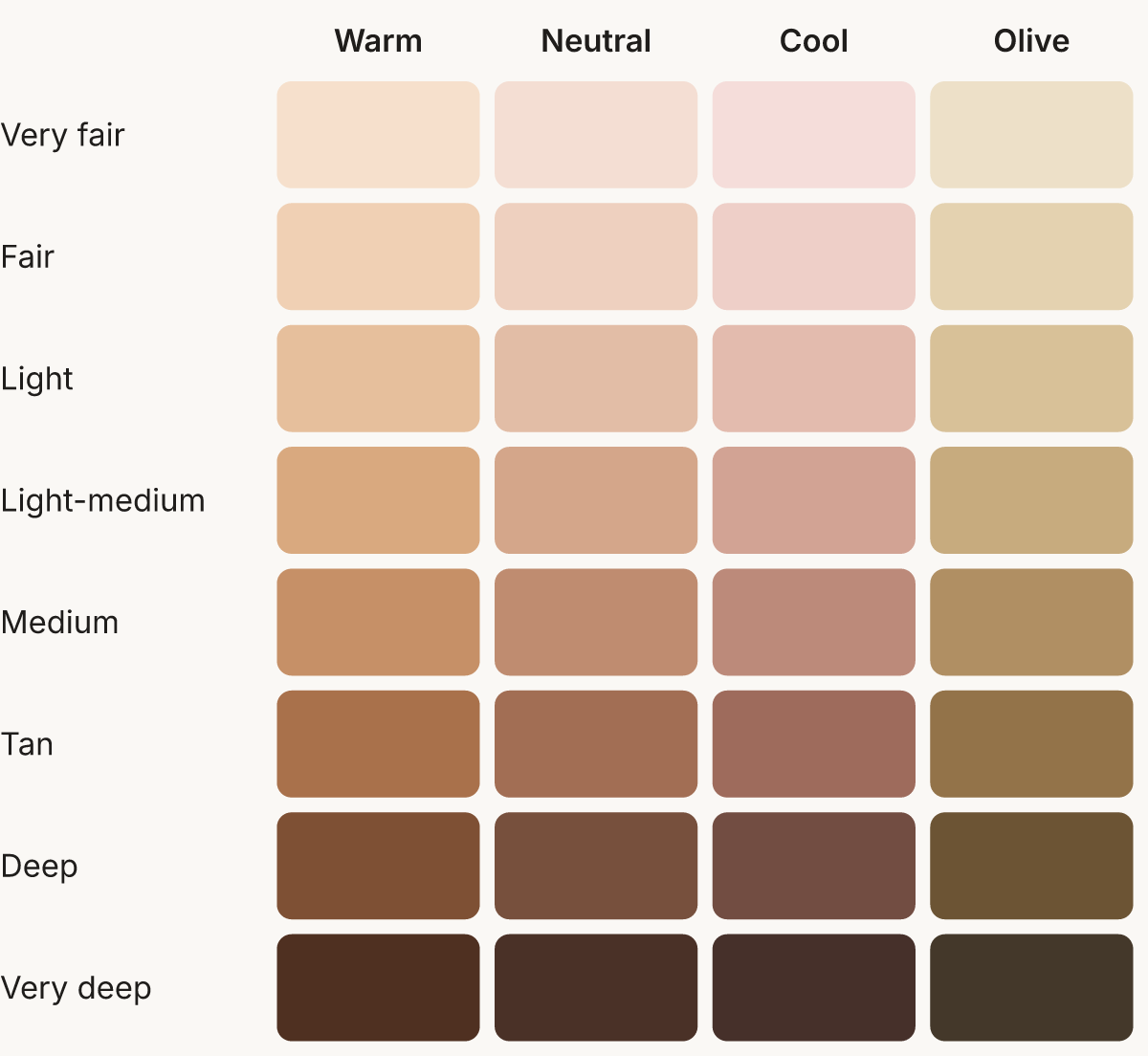
The rows run from very fair to very deep. The columns show the four undertones, each of which turns up at every depth. A person with very deep skin can have a golden undertone, and so can a person with very fair skin.
That is the main thing to take away. Depth and undertone are separate, so no single word can describe a skin color fully.
Words people use for skin colors
The vocabulary for skin is messy. Some words describe depth, some describe undertone, and some were invented to sell foundation.
Depth words
The common ones, roughly from lightest to deepest, are fair, light, medium, tan, brown and deep. "Pale" and "porcelain" usually mean the lightest end. "Dark" and "deep" both describe the other end; many brands and writers now prefer "deep" as a neutral description.
Undertone words
Warm, cool, neutral and olive describe the tint under the surface. You will also see golden, peach and yellow for warm, and pink, rosy or red for cool. "Olive" is the tricky one: some people use it to mean a medium depth, but in color analysis it means a green or grey-green cast at any depth.
Shade names and why plain words help
Foundation ranges often name shades after food or materials: ivory, honey, caramel, mocha, espresso. These names are memorable but vague, and two brands' "honey" can be far apart. Some people also find food words for brown skin uncomfortable.
When you describe skin, depth plus undertone is clearer and more respectful: "deep, cool" or "light, olive". If someone has their own word for their skin, use theirs. And avoid "nude" or "flesh" to mean beige; skin comes in far more colors than one.
Why skin color varies
Three things in the skin mix together to make the color you see. Melanin matters most.
Melanin
Melanin is the pigment made by cells called melanocytes. It comes in two main kinds: eumelanin, which is brown to black, and pheomelanin, which is red to yellow. Most people have a similar number of melanocytes. The difference lies in how much melanin those cells make, which kind, and how it is packaged and spread through the skin.
More eumelanin gives deeper skin. The balance between the two kinds helps shape whether skin reads golden, reddish or neutral.
Blood and carotene
Blood flowing near the surface adds pink and red, which is why thin or very fair skin flushes so visibly. Carotene, a yellow-orange pigment from foods such as carrots, adds a little yellow. Both are minor next to melanin, but they shift how a given depth looks.
Sunlight and ancestry
Over many generations, human populations living under strong year-round sun tended toward deeper skin. Populations farther from the equator tended toward lighter skin. Researchers link this to a balance between protection from ultraviolet light and making vitamin D in weaker sunlight. Skin color tells you very little about anyone's ancestry on its own, since every region shows a wide range.
Depth, undertone and surface redness
These three layers get mixed up all the time, and confusing them leads to the wrong foundation and the wrong colors.
- Depth is how light or deep your skin is. It moves with a tan.
- Undertone is the steady tint underneath. It does not change with the seasons.
- Surface redness is temporary or patchy pink: flushing, sun, wind, irritation or broken capillaries around the nose.
Redness is the classic trap. Pink cheeks can make a warm or olive person think they are cool. Check your undertone on the jawline or neck, where redness is lower, and see the undertone test for the full set of checks.
How skin color changes
Your skin color is not fixed through the year, even though your undertone is.
Sun exposure tells melanocytes to make more melanin, which deepens your skin over days. A tan then fades over several weeks as the outer skin renews. Many people sit a row or two deeper on the chart in late summer than in late winter.
Other changes are slower. Skin can look less rosy and slightly more sallow with age, and freckles or uneven patches can build up with sun. Hormonal shifts and some medications can also change pigment. If a patch of skin changes color suddenly or looks unusual, show it to a doctor.
Daily sunscreen helps keep your color even, whatever your depth.
Dressing for any skin color
You do not need a different rulebook for each skin color. Two questions cover almost everyone: how much contrast do you have, and which way does your undertone lean?
Contrast
Compare your skin with your hair and eyes. Deep skin with dark eyes, or fair skin with black hair, is high contrast. Fair skin with light hair, or deep skin with deep brown hair and eyes, can be lower contrast.
If your contrast is high, try bold pairings such as black with white or navy with lemon. If it is low, keep your outfit within a narrower range, such as taupe with soft rose.
Undertone
Start from the color family that matches your tint, then test in daylight.
If your undertone is warm, start here:
- Camel#C08C59
- Coral#EE7B5F
- Olive Green#6F7333
- Warm Ivory#F6EBD4
If your undertone is cool, start here:
- Navy#1F2A44
- Raspberry#B3245A
- Icy Grey#D5DAE0
- Emerald#127A55
If you are neutral, teal (#1F6F6B) and soft white (#F2F0EA) are easy wins. If you are olive, try forest green (#2E5A3A), aubergine (#4B2340) and khaki (#A39A72).
Putting it together
Contrast and undertone together point to a color season. Deep, warm skin with dark eyes often suits Deep Autumn. Fair, cool skin with ash hair often suits Light Summer. Clear, high contrast at any depth can mean Bright Winter. Every season includes a range of skin colors, so take the color analysis quiz rather than guessing from skin alone.
Frequently asked questions
There is no fixed number. Human skin forms a smooth range, and any count depends on where someone draws the lines. Our chart uses eight depths and four undertones because that is enough to choose clothes and foundation. Dermatology uses six Fitzpatrick types, which describe sun reaction rather than color, so the two counts measure different things.
Plain descriptions of depth and undertone work best: fair, light, medium, tan, deep, plus warm, cool, neutral or olive. They are specific and carry no judgement. If a person describes their own skin with a particular word, follow their lead. Skip phrases that treat one skin color as the default, such as "nude" for beige.
Yes. Skin color is shaped by many genes, and each child inherits a different mix from the same parents. Siblings can land several rows apart on a skin tone chart and in different undertone columns. That is also why siblings often end up in different color seasons, even when they look alike in other ways.
Often. Phone cameras adjust white balance and smooth skin, and many apps add warmth or brightness. Indoor bulbs tint everything yellow or blue. Deep skin in particular is often exposed badly by default settings. Judge your skin color by eye in daylight, and turn off beauty filters if you use your camera as a mirror.
Both. Match the depth first so the shade is not lighter or darker than your neck, then choose the undertone within that depth. A shade that is right in depth but wrong in undertone looks pink, orange or grey on the skin. Test two or three nearby shades on your jawline and check them by a window.
Keep reading
- Fair Skin: Undertones, Colors, Makeup, Hair and Sun CareWhat counts as fair skin, how to spot your undertone within it, and the clothes, makeup, hair colors and sun habits that suit each type.
- Skin Tone Chart: How to Read It and Find YourselfA skin tone chart with eight depths and four undertones, plus how to read the rows and columns and use your spot for clothes and foundation.
- What Is My Skin Tone? How to Find It in 3 StepsA ten-minute, step-by-step way to determine your skin tone: depth from the chart, undertone from four simple tests, and what to do with the result.
- Color analysis quizFind your color season in 13 questions.
- Undertone testWarm, cool, neutral or olive.
- Face shape toolMeasure from a photo or by hand.