Guide
What Is My Skin Tone? How to Find It in 3 Steps
To answer "what is my skin tone", you need two things: your depth and your undertone. Find your depth by holding the chart below beside your jawline in daylight. Then find your undertone with three or four quick tests at a window. Your answer will read like "medium, olive" or "fair, cool", and the whole process takes about ten minutes.
What you need before you start
Gather these first so you can do every test in one sitting, in the same light.
- A window with indirect daylight, ideally late morning or early afternoon. Avoid direct sun and avoid lamps.
- Clean, bare skin: no foundation, tinted moisturiser or self-tan, and wait a while after a hot shower.
- A sheet of bright white printer paper and something cream or ivory, such as a cream towel or notepad.
- One gold piece of jewelry and one silver piece.
- A mirror, or your phone's front camera with filters and beauty mode switched off.
- Something to write on, so you can tally your results.
Pull your hair back and take off any colored top near your face. A white T-shirt or a towel over your shoulders works.
Step 1: Find your skin depth
Depth is the easier half. It simply means how light or deep your skin is.
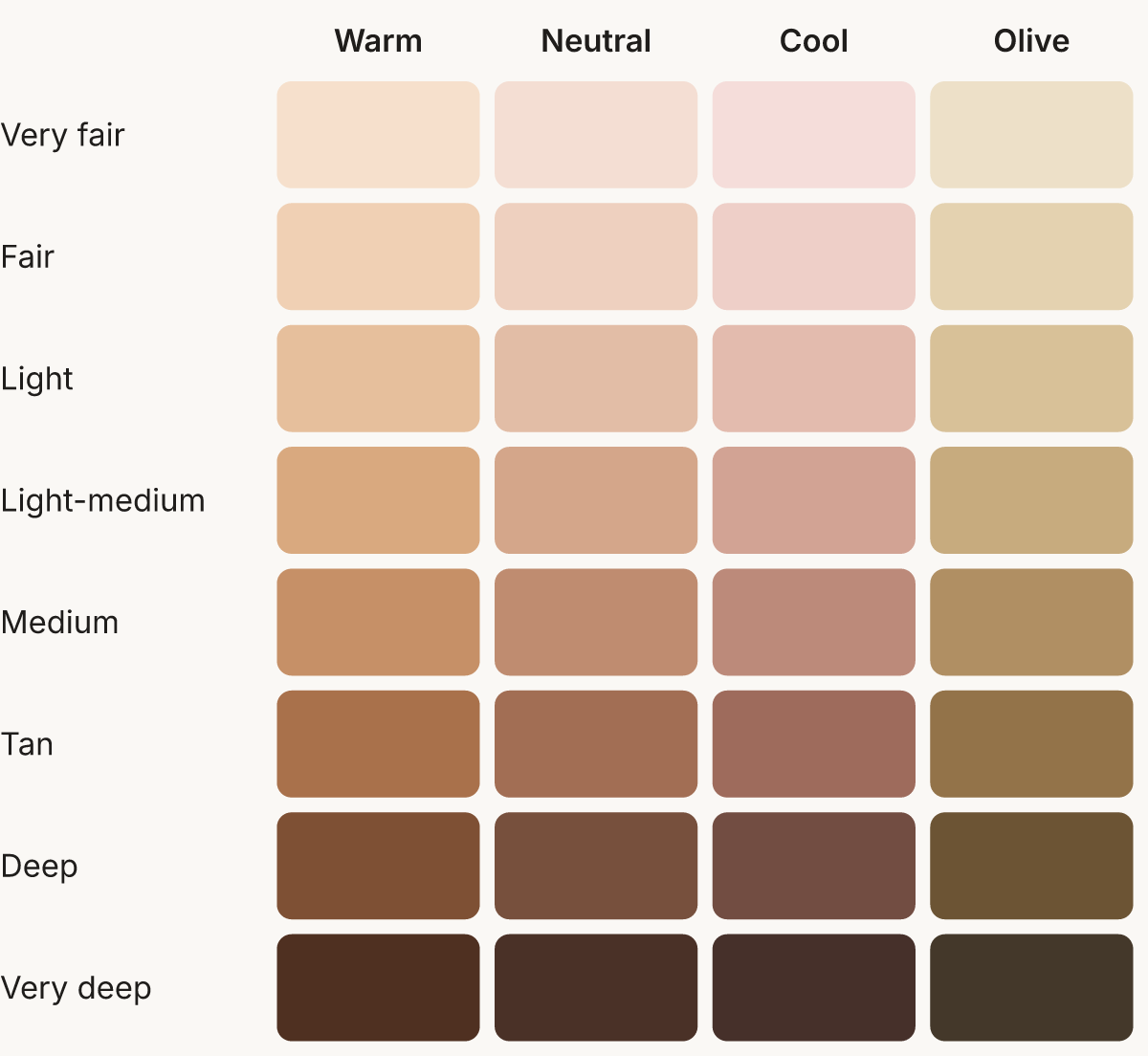
Hold the chart, on screen or printed, right beside your jawline. Look at your skin and the swatches together in the mirror. Start at the top row and move down until a swatch looks clearly deeper than you, then go back up one row. That row is your depth.
If you sit between two rows, write down both, such as "light to light-medium". Many people do, and it is useful information for foundation.
Check your inner arm too. If it is two or more rows lighter than your face, your face probably has a tan or sun exposure. For clothes and makeup, your face and neck are what count.
Step 2: Find your undertone
Undertone is the tint beneath the surface. Do each test below and mark the result: warm, cool, neutral or olive.
Test A: Bare skin in daylight
Look at your jawline in the mirror for a few seconds. Ask yourself whether it leans golden or peach, pink or rosy, plain beige, or slightly green and khaki. Write down your first impression, even if you are unsure.
Test B: White paper against cream
Hold the white sheet under your chin, then swap to the cream one. Watch your skin, not the paper. If you look clearer with white, mark cool. If cream looks kinder, mark warm. If you cannot see a difference, mark neutral. If both make you look a little grey or green, mark olive.
Test C: Your wrist veins
Turn your wrist up to the window. Blue or purple veins lean cool, green veins lean warm, and an even mix leans neutral. This test is the least reliable of the four, especially on deep skin. Read the full vein test guide for why, and weigh it lightly.
Test D: Gold against silver
Lay the gold piece on the back of your hand or near your collarbone, then the silver. The one that makes your skin look smoother and more even is your answer. Gold suggests warm, silver suggests cool, both equally suggests neutral. If neither looks quite right, olive is worth considering.
Count your results
Look for the answer that came up most often. Three out of four is a clear result. A split between warm and cool usually means neutral. A pattern of "nothing looks right" usually means olive.
If you want a second opinion, the undertone test asks seven questions and adds a lipstick check you can do at home.
Step 3: What is my skin tone? Put it together
Combine your depth from Step 1 with your undertone from Step 2. Some examples:
- "Fair, cool": very light skin with a pink or rosy tint.
- "Medium, warm": a clear mid-depth with a golden cast.
- "Tan, olive": golden-brown skin with a green-grey note.
- "Very deep, neutral": the deepest depths with no strong lean.
Write it down somewhere you will see it when shopping. It is the same shorthand most foundation ranges use.
Common mistakes when finding your skin tone
Most wrong answers come from a handful of avoidable slips.
- Testing under indoor bulbs. Warm bulbs make everyone look golden, and cool LEDs make everyone look pink. Daylight only.
- Reading redness as cool. Flushed cheeks, rosacea or a sunburn add pink on top. Check your jawline and neck instead.
- Reading a tan as warm. A tan deepens your depth but does not change your undertone. Test in your palest month if you can.
- Judging by dyed hair. Hair you colored yourself says nothing about your skin. Use your natural root color.
- Trusting your camera. Phone cameras shift white balance on their own. Use a mirror, or turn off every filter.
- Expecting every test to agree. Two or three matching results are enough. Perfect agreement is rare.
What to do with your skin tone
Your answer is only useful if you act on it. Here are three places to start.
Find your foundation shade
Use your depth to choose the number range and your undertone to choose the letter or label, such as W, N, C or olive. Swatch three shades in a vertical stripe on your jawline. Step to a window after a few minutes. The stripe that vanishes into your neck is your match. If two vanish, pick the lighter one for winter and the deeper one for summer.
Choose clothes near your face
Your undertone picks the color temperature. If you are warm, try a camel (#C08C59) coat over a cream (#F3E7D3) top. If you are cool, try a navy (#1F2A44) blazer with a soft pink (#E8B4C0) shell. If you are olive, try a forest green (#2E5A3A) knit with khaki (#A39A72) trousers. If you are neutral, a teal (#1F6F6B) top with off-white trousers is a safe start.
Your depth guides contrast. Deeper rows tend to suit stronger contrast near the face, such as white against black. Lighter rows tend to suit softer pairings, unless your hair is very dark.
Find your color season
Skin tone is one input to color analysis; your hair and eyes are the others. The color analysis quiz combines all three and points you to one of all 12 seasons. If you already know you are cool and fair, start by reading Cool Summer. If you are warm and deep, start with Deep Autumn.
Frequently asked questions
Depth is usually easy: you will sit in the deep or very deep row. For undertone, veins are hard to see, so skip that test. The paper, jewelry and lipstick checks work well. Deep skin can be warm with red-gold notes, cool with blue or plum notes, neutral or olive, and many foundation ranges now label deep shades that way.
Our undertone quiz asks about how your skin reacts to sun, jewelry and colors, and gives a warm, cool, neutral or olive result. It cannot see your skin, so pair it with the chart and the daylight tests on this page. Photo-based tools are affected by your camera and lighting, so treat their answers as a rough guess.
Your depth often is. Faces get more sun and more redness, so they can read a row deeper or pinker than your chest or arms. Your undertone is normally the same everywhere. Choose foundation by your jawline and neck, and if your face is noticeably darker, blend foundation down onto your neck.
Your undertone rarely changes, so one careful check is usually enough. Your depth shifts with tanning, so recheck it at the start of summer and winter if you wear foundation. If you have stopped tanning, started a new skincare routine or moved somewhere much sunnier, a quick look against the chart is worthwhile.
Check your conditions first: the same window, the same time of day, no makeup and no colored clothing near your face. If answers still change, you are probably neutral or olive, since both give mixed signals. Try draping one warm and one cool fabric, such as rust and fuchsia, and see which looks calmer.
Keep reading
- Fair Skin: Undertones, Colors, Makeup, Hair and Sun CareWhat counts as fair skin, how to spot your undertone within it, and the clothes, makeup, hair colors and sun habits that suit each type.
- Skin Tone Chart: How to Read It and Find YourselfA skin tone chart with eight depths and four undertones, plus how to read the rows and columns and use your spot for clothes and foundation.
- Skin Colors: The Full Range and What Shapes YoursThe full range of human skin colors, the clearest words to describe them, why skin color varies, and how to dress for any of them.
- Color analysis quizFind your color season in 13 questions.
- Undertone testWarm, cool, neutral or olive.
- Face shape toolMeasure from a photo or by hand.