Guide
Skin Tone Chart: How to Read It and Find Yourself
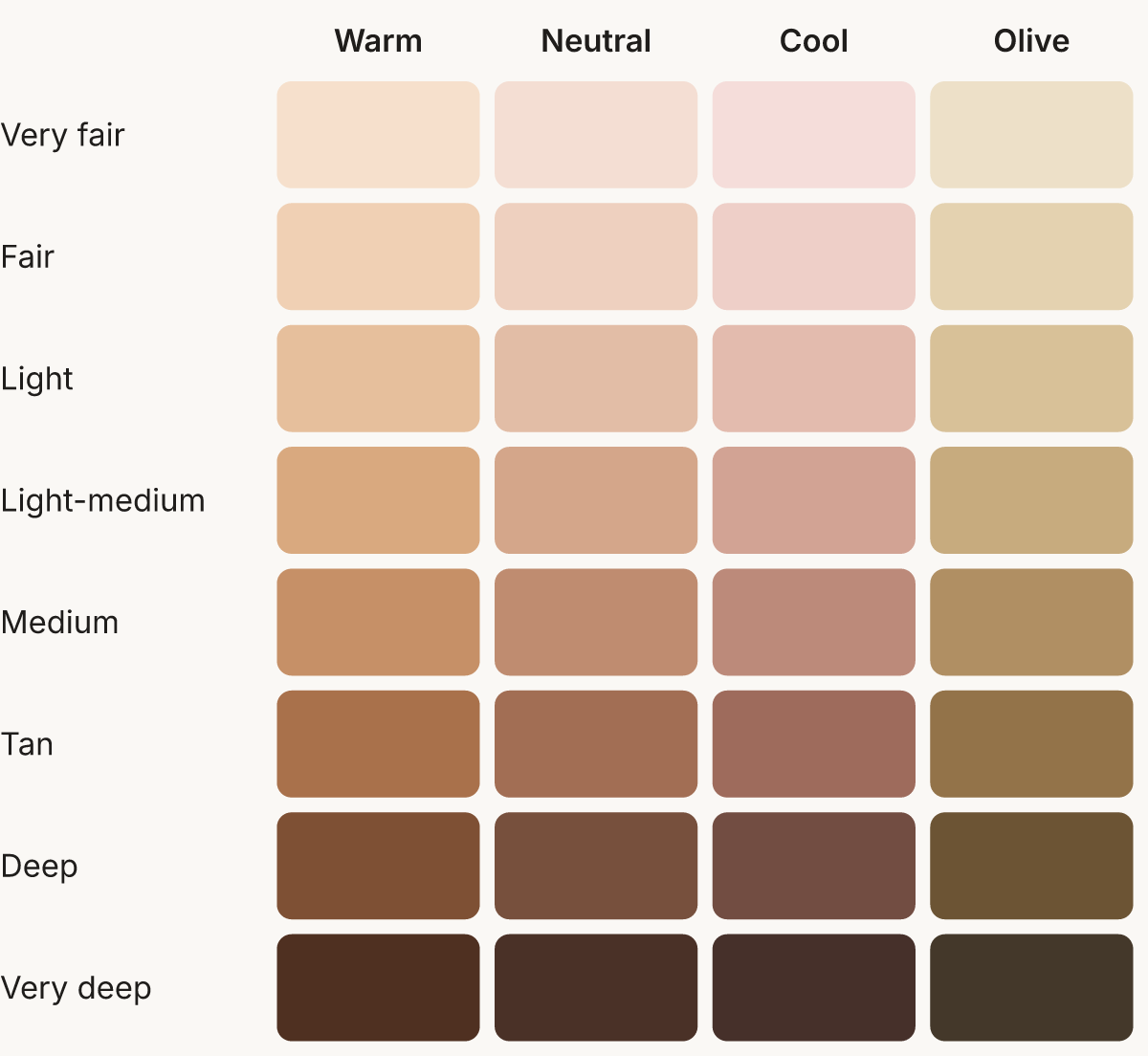
A skin tone chart sorts skin along two lines at once. The rows show depth, meaning how light or deep your skin is. The columns show undertone, the warm, neutral, cool or olive tint underneath. To read it, find your row first and your column second. Our chart has eight depths and four undertones, so 32 swatches in all.
How to read a skin tone chart
Think of the chart as a map with two coordinates. Moving down a column, the skin gets deeper but keeps the same tint. Moving along a row, the depth stays the same but the tint shifts from golden to beige to rosy to greenish.
That split matters because the two coordinates do different jobs. Depth tells you how much contrast you can carry and which foundation number to look for. Undertone tells you whether warm or cool colors sit better on you.
Every swatch is an average. Real skin varies inside each cell, and your face, neck and arms may not even match each other. Treat the swatch you land on as a neighbourhood, not an exact address.
The eight depths, row by row
Here is what each row covers, with the neutral swatch from the chart as a reference point.
- Very fair (#F4DED3): the lightest row. Veins show clearly and the skin often looks translucent at the temples.
- Fair (#EED0BF): still light, with a little more color. Pastels can work, but stark black often looks heavy.
- Light (#E2BDA6): light skin that holds a light tan. Mid-tone colors start to look balanced rather than strong.
- Light-medium (#D4A68A): the middle ground, often called beige or light tan in foundation ranges.
- Medium (#BF8C70): a clear mid-depth. Most saturated colors sit well here without overpowering you.
- Tan (#A26E54): golden or caramel-brown depth. Rich colors look at home here, and so do clean whites.
- Deep (#77503D): deep brown. Strong color and high contrast tend to look natural, not loud.
- Very deep (#4A3127): the deepest row. Bright white, jewel tones and clear brights stand out in a flattering way.
Depth words are loose. One brand's "medium" is another's "light-medium", so use the chart's swatches rather than the label alone.
The four undertone columns
Compare the medium row across the chart to see how the columns differ. The depth is the same; only the tint changes.
- Warm (#C69067): a golden, peach or yellow cast. Gold jewelry tends to melt into this skin.
- Neutral (#BF8C70): beige with no strong lean either way. Both gold and silver usually work.
- Cool (#BC8A7A): a pink, rosy or bluish cast. Silver and white gold tend to look brighter on it.
- Olive (#B08F63): a green or grey-green note, often mixed with gold. It can look khaki next to white.
Olive is easy to miss on a chart because it sits between warm and neutral. If no warm or neutral swatch feels quite right and your skin looks a little green in daylight, check the olive column.
Finding yourself on the skin tone chart
Open the chart on a phone or laptop with the brightness at about half. Stand by a window in daylight, with clean skin and no self-tan. Hold the screen beside your jawline, not your cheek, since cheeks often carry extra redness.
Pick the row first. Slide down until a swatch looks slightly too deep, then step back one row. If you sit between two rows, note both; that is normal.
Then choose the column. This step is harder by eye, so back it up with the undertone test, which walks you through paper, jewelry and lipstick checks. For a full walkthrough with every test in order, see what is my skin tone.
Screens shift color, and printed charts fade. Use the chart to narrow things down, then confirm with fabric and makeup in real light.
The Fitzpatrick scale: a sun scale, not a color guide
You may see the Fitzpatrick scale printed next to skin tone charts. Dermatologist Thomas Fitzpatrick created it in 1975, and later expanded it, to describe how skin reacts to ultraviolet light. It sorts skin into six types by how easily it burns and how readily it tans.
In brief, type I always burns and does not tan. Type VI almost never burns and is deeply pigmented. Types II to V fall in between, each burning less and tanning more readily than the last.
The scale is a sun-reaction tool used in dermatology. It says nothing about undertone, so two people of the same type can need very different colors. It also groups a wide range of brown and deep skin into just two types, which makes it a poor guide for clothes or foundation. Use it for sun-care conversations, and use the chart for color.
Using your place on the chart
Once you have a row and a column, you have two pieces of practical information. Here is how to use each one.
Clothes: depth sets contrast, undertone sets temperature
Your row hints at how much light-dark contrast you wear well. If you sit in the fair rows with light hair, soft contrasts such as dove grey (#B9B4AE) with powder blue (#AFC4DA) tend to look balanced. If you sit in the deep rows, try crisp pairings such as optic white (#FAFAFA) with cobalt (#1F4FA8).
Your column tells you which family of colors to start from. Warm columns usually suit camel, coral and olive green. Cool columns usually suit navy, raspberry and icy grey. Neutral sits between, so teal and soft white tend to be safe. Olive often looks best in forest green, aubergine and khaki.
Hair and eye color change the picture, so treat these as starting points. The color analysis quiz combines all three.
Makeup: match both coordinates
Many foundation ranges use a number for depth and a letter or word for undertone, such as W, N, C or "olive". Systems vary by brand, so read each brand's own key. Your chart row tells you roughly where on the number scale to start. Your column tells you which letter to pick.
Swatch two or three shades on your jawline and check them in daylight. The right one disappears into your neck; the wrong undertone shows up as a pink, orange or grey stripe.
Seasons: a rough first guess
Your place on the chart can point toward a few color seasons. These are common patterns, not rules.
- Fair to light, cool: try Light Summer or Cool Summer.
- Fair to light, warm: try Light Spring.
- Medium to tan, warm: try Warm Autumn.
- Deep to very deep, warm: try Deep Autumn.
- Deep to very deep, cool: try Deep Winter.
- Olive at any depth: try Soft Autumn or Soft Summer.
Every season includes a wide range of depths, so deep skin can still land in a soft season and fair skin in an Autumn. Browse all 12 seasons if none of these fit.
Frequently asked questions
People use the two names for the same thing. Some skin color charts show depth only, a single strip from light to deep. A skin tone chart with undertones adds columns for warm, neutral, cool and olive. The second kind is more useful for clothes and makeup, because two people at the same depth can need opposite colors.
Yes. Download the PNG under the chart and print it on plain white paper. Printers shift color, so compare the print with the screen version first. Keep it out of direct sun, since faded ink makes every swatch look cooler. Use it as a rough guide and confirm with fabric or foundation in daylight.
Your face gets more sun, more redness and more skincare than your inner arm, so it often reads a shade deeper or pinker. For clothes, go by your face and neck, since that is what sits next to a collar. For foundation, match the jawline so your face blends into your neck.
Your row can move down one or two steps in summer and back up in winter. Your column usually stays put, because undertone does not change with a tan. If you tan a lot, keep two foundation shades and blend them in between seasons. Your color season normally stays the same all year.
No chart can show every real skin tone. Ours splits a continuous range into 32 averaged swatches, and many people fall between cells. Any ethnicity can appear at many depths and in any undertone column. If you cannot find a close match, pick the nearest row and column and lean on the undertone tests instead.
Keep reading
- Fair Skin: Undertones, Colors, Makeup, Hair and Sun CareWhat counts as fair skin, how to spot your undertone within it, and the clothes, makeup, hair colors and sun habits that suit each type.
- Skin Colors: The Full Range and What Shapes YoursThe full range of human skin colors, the clearest words to describe them, why skin color varies, and how to dress for any of them.
- What Is My Skin Tone? How to Find It in 3 StepsA ten-minute, step-by-step way to determine your skin tone: depth from the chart, undertone from four simple tests, and what to do with the result.
- Color analysis quizFind your color season in 13 questions.
- Undertone testWarm, cool, neutral or olive.
- Face shape toolMeasure from a photo or by hand.